
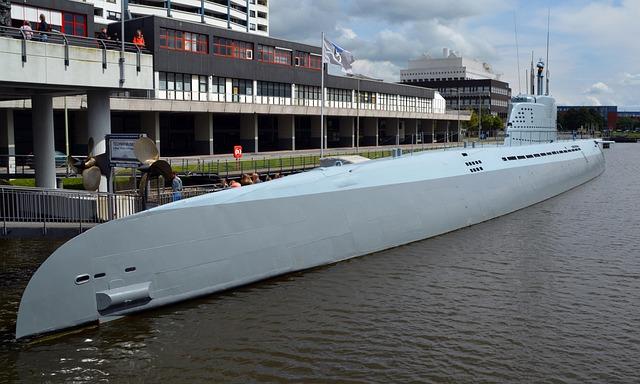
Israel has officially delivered its first autonomous submarine to Germany, marking a significant milestone in defense technology and international military collaboration. This groundbreaking vessel, equipped with advanced capabilities for underwater operations, reflects Israel’s growing expertise in autonomous maritime systems and strengthens bilateral ties between the two nations. The delivery underscores a strategic shift towards integrating unmanned platforms in naval defense, highlighting evolving security priorities amid global maritime challenges.
Israel Completes Delivery of Cutting-Edge Autonomous Submarine to German Navy
In a landmark achievement for naval technology, Israel has finalized the delivery of its state-of-the-art autonomous submarine to the German Navy. This groundbreaking vessel represents a significant advancement in underwater warfare capabilities, combining cutting-edge AI navigation systems with stealth technology to conduct covert operations without direct human oversight. The autonomous submarine is equipped with advanced sonar, mine detection, and intelligence-gathering instruments, enabling it to perform a variety of complex missions in high-risk environments.
The German Navy is set to integrate this asset into its fleet as part of a broader modernization strategy aimed at enhancing maritime security and operational flexibility. Key features of the autonomous submarine include:
- Adaptive AI navigation that allows independent decision-making and route optimization.
- Reduced acoustic signature for enhanced stealth and survivability under water.
- Modular payload systems to customize mission parameters ranging from reconnaissance to electronic warfare.
This delivery marks the first of its kind, symbolizing deepening defense collaboration between Israel and Germany, and signals a new era of robotic warfare beneath the waves.
Strategic Implications for European Maritime Security and Regional Defense Cooperation
The delivery of Israel’s first autonomous submarine to Germany marks a significant shift in the maritime security dynamics of Europe. This groundbreaking technology not only enhances Germany’s underwater operational capabilities but also signals a broader strategic recalibration amid evolving threats in the region. The integration of unmanned systems into naval fleets strengthens deterrence by providing enhanced stealth, endurance, and data-gathering capacities. This capability is critical as naval powers across Europe face increasing challenges from rival states and non-state actors exploiting undersea domains.
Moreover, this development is poised to catalyze deeper regional defense cooperation within Europe. Nations bordering critical maritime chokepoints, such as the Baltic and North Seas, are expected to leverage such autonomous technologies to bolster joint surveillance and rapid-response efforts. Key strategic implications include:
- Enhanced interoperability of European naval forces through shared autonomous platforms and data networks.
- Potential for expanded defense technology partnerships between Israel, Germany, and other NATO members.
- A shift towards multi-layered maritime defense architectures integrating unmanned vessels alongside traditional fleets.
- Increased emphasis on protecting critical infrastructure like undersea cables and offshore energy installations.
As Europe contends with a complex security environment marked by renewed great power competition and hybrid threats, this acquisition underscores the imperative of innovation and collective defense in securing its maritime interests.
Recommendations for Enhancing Autonomous Underwater Capabilities and Joint Operational Training
To maximize the strategic advantage offered by the new autonomous submarine, it is imperative to invest in cutting-edge sensor integration and AI-driven navigation systems. Enhancing underwater communication networks will ensure seamless data exchange during extended missions, enabling real-time decision-making and threat detection. Furthermore, prioritizing modular payload designs can provide operational flexibility, allowing swift adaptation to diverse mission profiles ranging from intelligence gathering to mine countermeasures.
Joint operational training must emphasize comprehensive interoperability between Israeli and German naval units, focusing on synchronized maneuvering and multi-domain coordination. Incorporating simulated exercises using augmented reality environments will bolster crew readiness in handling complex underwater scenarios. Additionally, establishing shared protocols and standardized communication frameworks will pave the way for cohesive mission planning and execution, reinforcing the strategic partnership between the two nations.
- Advanced AI-powered detection and evasion systems integration
- Resilient undersea communication infrastructure
- Modular payload versatility for multifaceted missions
- Joint simulation training leveraging augmented reality
- Unified command and communication protocols
Future Outlook
The delivery of Israel’s first autonomous submarine to Germany marks a significant milestone in defense collaboration between the two nations. As autonomous technologies continue to reshape modern naval capabilities, this advancement underscores the growing strategic importance of unmanned systems in maritime security. Both countries are expected to further deepen their partnership, potentially setting new benchmarks in underwater defense innovation. The coming months will reveal how this cutting-edge asset integrates into Germany’s naval operations and influences broader regional security dynamics.